°1979 – Lives and works in Liège.
“Olivier Bovy’s works have sometimes been described as modest; more appropriate would be delicacy or politeness. Like irreproachable hosts, they place themselves at the service of the viewer. By modifying the relationship to space, they invite movement, by modifying the relationship to listening, they fix attention: they belong to what is known as “interactive art”. It’s up to the viewer, in turn, to respond to this hospitality by becoming active.
Urban soundscapes, like other types of landscape, bear the scars of modernity. Certain sounds that once punctuated daily life have disappeared. Olivier Bovy’s works act precisely at this point: they invite us to reinvest in the sound dimension of life, whether collective or intimate. Collective, when the work proposes the invention of a ritual, such as Sons de cloches (2014-2018), two spaced bells that can be activated at will, to signify one’s presence, launch a call or communicate between two points. Intimate when the work catches the passer-by and creates a bubble for him or her in the public space, like the underground, invisible sound fountain entitled Il y a quelqu’un dans la pièce (2013-2019).
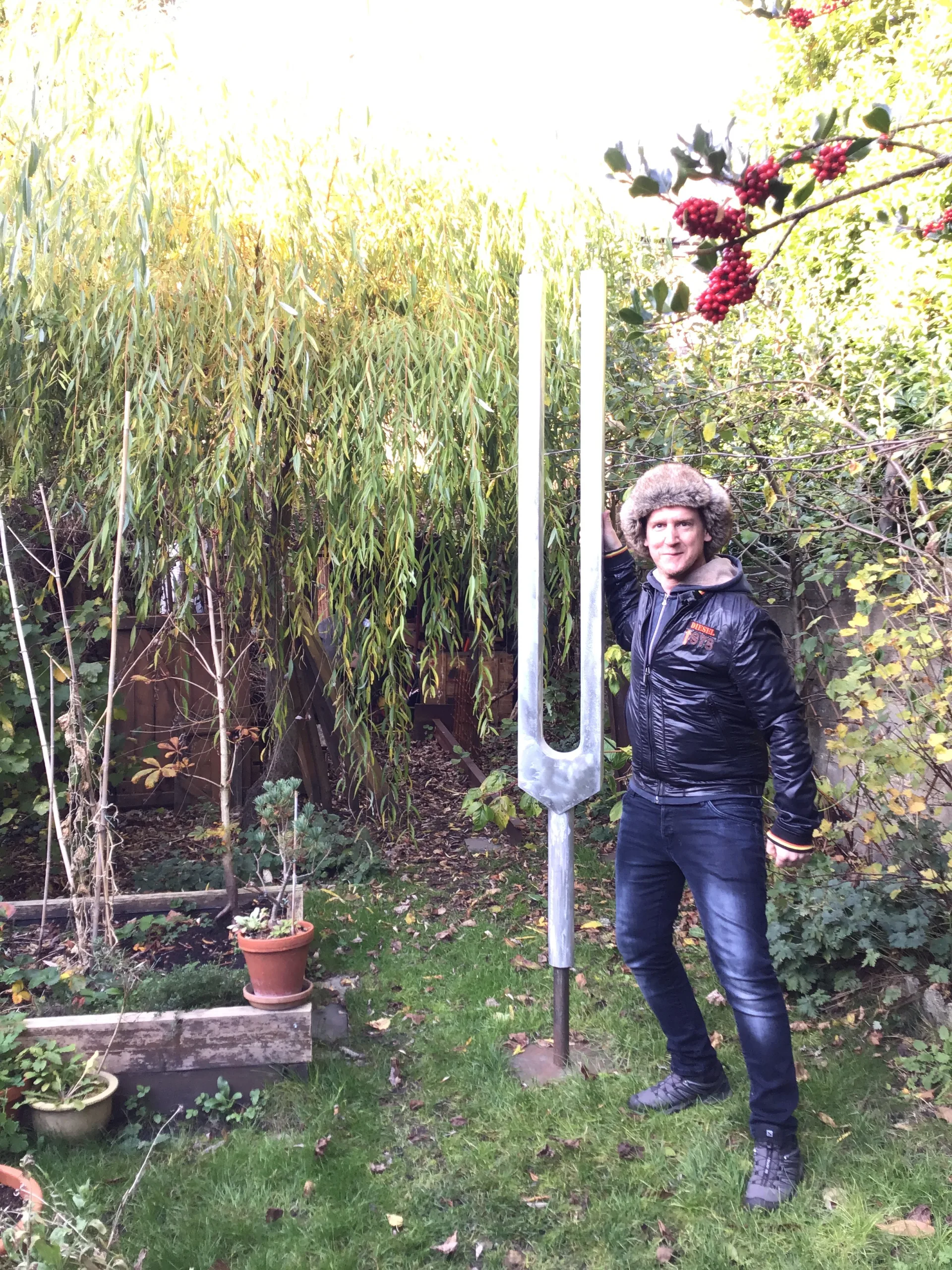
Through its powerful evocative power and ability to color the atmosphere, sound has a profound effect on the viewer. Olivier Bovy, who is interested in ethno-acoustics and the therapeutic virtues of sound, works as much as possible in its raw materiality, giving preference to natural sounds such as breathing and surf. In a quest for instinctive recognition by the public, the shapes assert their function. Their extreme stylization has stripped them of all embellishment: generic, essential, they are reduced to the bone. The same goes for color, stripped of all pathos, dictated by the material, as in Mahakala (2019), a monumental tuning fork in aluminum. Olivier Bovy’s practice could be summed up in this simple but powerful idea: his works are based on an aesthetic of attention, where the very act of experiencing the device composes its sensitive part. No work without a viewer: we knew that. With Olivier Bovy: we experience it.” -Lætitia Chauvin